Best OCR API in 2026 for Driver License Data Extraction is becoming a critical topic for businesses that rely on fast, secure, and accurate identity verification. From fintech platforms and insurance providers to car rental companies and workforce onboarding systems, organizations are increasingly looking for automated ways to extract information from driver licenses without manual data entry.
As digital identity verification becomes a standard part of customer onboarding in 2026, the volume of identity documents being processed continues to grow. Businesses are expected to verify users quickly while maintaining compliance with regulatory requirements and protecting against fraud. Manually reviewing driver licenses and entering data into internal systems is not only time-consuming but also prone to errors that can slow down operations and create compliance risks.
Traditional verification processes often require staff to manually capture details such as the license number, holder’s name, date of birth, address, issue date, and expiration date. This approach can lead to inconsistent data quality, delayed onboarding, and increased operational costs.
It also becomes difficult to scale as customer acquisition grows.
AI-powered OCR APIs have transformed this process by automatically extracting structured data from driver license images, scanned documents, and mobile uploads within seconds. Modern OCR technology goes beyond simple text recognition by understanding document layouts, identifying relevant fields, validating extracted information, and helping detect potential fraud indicators.
Solutions such as AZAPI.ai, Figment Global, RPACPC are helping organizations automate driver license data extraction, enabling faster onboarding experiences while reducing manual workload. By leveraging AI-powered OCR, businesses can improve operational efficiency, strengthen compliance processes, and deliver a smoother customer journey.
In this guide, you’ll learn how driver license OCR works, the key features to evaluate in an OCR API, the challenges of manual verification, and the factors that matter most when selecting the right solution for identity verification and document automation in 2026.
What Is Driver License OCR?
Driver License OCR (Optical Character Recognition) is a technology that automatically extracts information from a driver’s license and converts it into structured digital data. Instead of manually entering details from a physical or scanned license, businesses can use OCR to capture information within seconds.
How Driver License Data Extraction Works
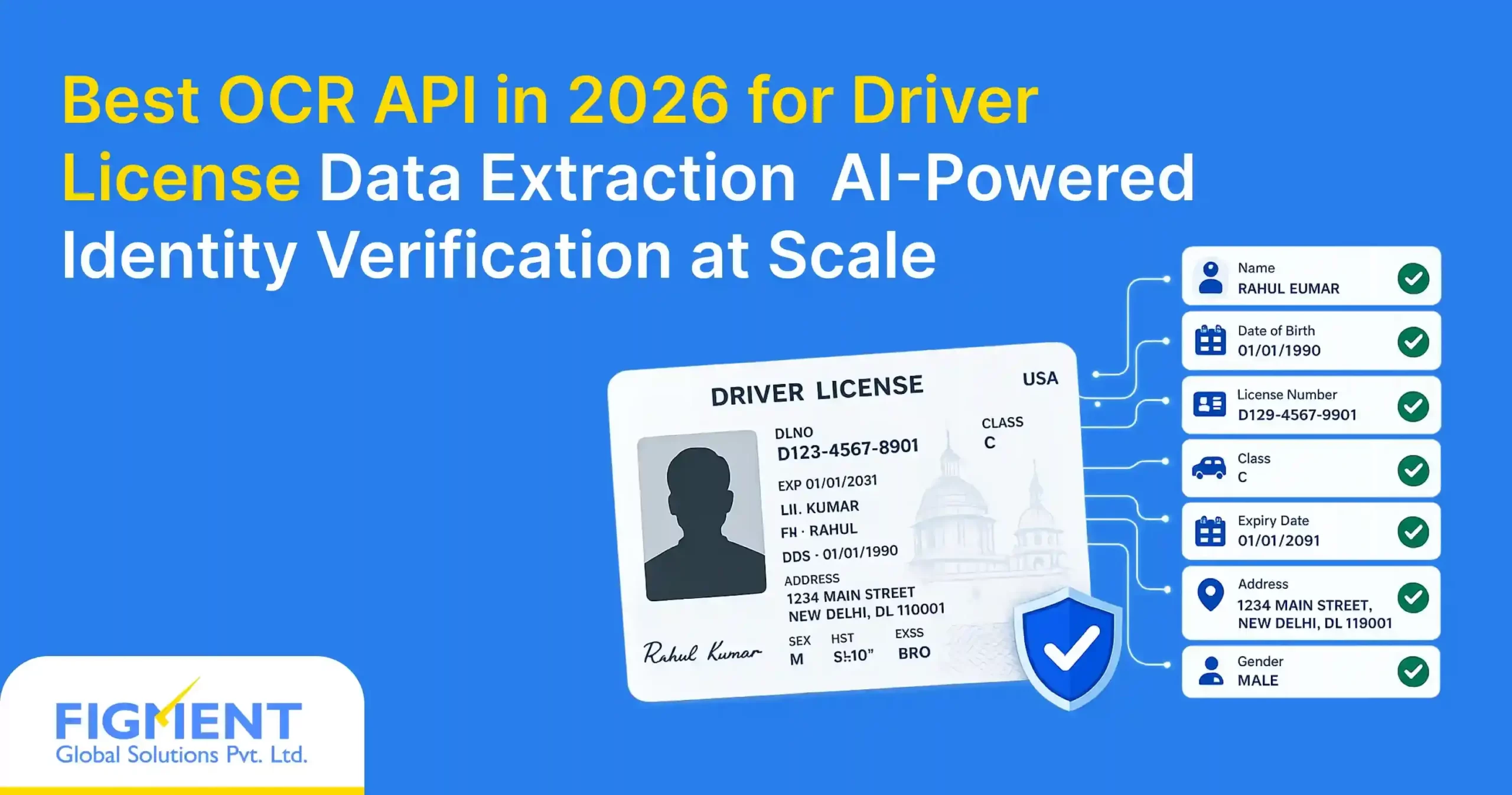
The process begins when a user uploads a driver license image, scanned copy, or mobile photo. With the help of a Driving Licence OCR API, the system analyzes the document, identifies important fields, and extracts data such as the holder’s name, license number, date of birth, address, issue date, and expiration date. The extracted information can then be transferred directly into business applications or verification systems, enabling faster and more accurate data processing.
OCR vs Traditional Data Entry
Traditional data entry relies on employees manually reviewing licenses and typing information into databases. This approach is slow, expensive, and vulnerable to human errors. OCR automates the process, reducing manual effort while improving speed and consistency.
AI-Powered OCR vs Basic OCR
Basic OCR focuses primarily on converting printed text into digital text. While effective for simple documents, it often struggles with varying license formats, image quality issues, and complex layouts.
AI-powered OCR goes a step further by understanding document structure and context. It can identify specific fields, handle different license designs, improve extraction accuracy, and assist in detecting inconsistencies that may indicate fraud.
Why Driver License OCR Matters for Identity Verification
Organizations across finance, insurance, transportation, telecommunications, and online services increasingly rely on driver licenses as part of their identity verification process. Automated extraction helps accelerate customer onboarding, reduce operational costs, improve compliance, and create a smoother user experience.
As digital verification becomes increasingly important, businesses are actively evaluating the Best OCR API in 2026 for Driver License Data Extraction to automate document processing, improve onboarding efficiency, strengthen fraud prevention, and ensure higher data accuracy across identity verification workflows.
Why Businesses Use OCR APIs for Driver License Data Extraction
As digital onboarding becomes the norm, businesses are under pressure to verify customer identities quickly without compromising security or compliance. Driver license OCR APIs help automate the extraction of identity information, allowing organizations to process documents faster and more accurately than traditional manual methods.
Faster Customer Onboarding
Manual document review can slow down registration and verification processes. OCR technology extracts driver license information in seconds, helping businesses onboard customers more efficiently and reduce abandonment rates.
Reduced Manual Verification Costs
Identity verification often requires significant staff involvement. By automating data capture, businesses can reduce the time spent on manual data entry and document review, lowering operational costs.
Improved Data Accuracy
Human errors are common when entering information from identity documents. OCR APIs minimize these mistakes by automatically capturing key fields such as name, license number, address, and date of birth directly from the document.
The growing demand for the Best OCR API in 2026 for Driver License Data Extraction reflects the need for solutions that can balance speed, accuracy, and compliance while handling increasing verification volumes.
Better Customer Experience
Customers expect fast and frictionless onboarding. Automated document processing eliminates repetitive form filling and reduces waiting times, creating a smoother user experience.
Regulatory Compliance Support
Many industries must comply with KYC, AML, and identity verification regulations. OCR-based data extraction helps maintain accurate records and supports compliance workflows.
Scalable Identity Verification Workflows
As businesses grow, manual verification processes become difficult to manage. OCR APIs enable organizations to handle larger volumes of driver license verifications without significantly increasing operational resources.
By automating document processing, businesses can improve efficiency, strengthen security, and create a more scalable approach to digital identity verification.
What Information Can Be Extracted from a Driver License?
Modern OCR technology can extract a wide range of data fields from driver licenses, transforming physical or digital identity documents into structured information that can be used for verification, onboarding, and compliance processes. This eliminates the need for manual data entry and helps organizations process identity documents more efficiently.
Full Name
The license holder’s complete name is one of the primary fields extracted and used for identity verification.
Driver License Number
OCR systems can accurately capture the unique driver license number, which is often required for authentication and record management.
Date of Birth
The holder’s date of birth is extracted to verify age requirements and confirm identity details.
Address
Residential address information can be captured automatically, reducing manual entry and improving data accuracy.
Issue Date
The issue date indicates when the license was originally issued and can be important for verification and record-keeping purposes.
Expiration Date
OCR systems can identify the license expiration date, helping businesses ensure that submitted documents remain valid.
License Class
Many driver licenses include classifications that specify the types of vehicles the holder is authorized to operate. These details can also be extracted automatically.
Gender
Where available on the document, gender information can be captured as part of the identity verification process.
Issuing Authority
The authority or government agency responsible for issuing the license can also be identified and extracted.
Advanced OCR solutions can capture these fields from scanned documents, PDFs, and mobile images with minimal human intervention. For organizations handling large volumes of identity verification requests, selecting the Best OCR API in 2026 for Driver License Data Extraction can help improve accuracy, accelerate onboarding, and create a more efficient document verification workflow.
How AI-Powered Driver License OCR Works
Organizations searching for the Best OCR API in 2026 for Driver License Data Extraction often focus on how modern OCR systems transform a simple image of a driver’s license into structured, verified identity data. Today’s AI-powered solutions combine image processing, text recognition, and validation technologies to automate the entire workflow.
Step 1: Document Capture
The process starts with collecting the driver’s license image. Documents can be submitted through multiple channels, including:
- Mobile camera capture
- Uploaded image files
- PDF documents
This flexibility allows businesses to support both online and mobile onboarding experiences.
Step 2: Image Preprocessing
Before text extraction begins, the system improves document quality to increase recognition accuracy.
- Noise Reduction: Removes unwanted visual artifacts.
- Perspective Correction: Straightens tilted or angled document images.
- Glare Removal: Reduces reflections caused by lighting conditions.
- Image Enhancement: Improves clarity and readability.
Step 3: OCR Text Recognition
The OCR engine analyzes the document and converts visual information into machine-readable text.
- Character Detection: Identifies letters, numbers, and symbols.
- Text Recognition: Extracts readable text from the document.
- Barcode Reading: Captures information stored in machine-readable barcodes when available.
Step 4: Data Classification
Once text is extracted, AI models organize and classify the information.
- Field Identification: Locates key data fields.
- Document Structure Analysis: Understands the layout of the license.
- Driver License Parsing: Maps extracted information to predefined identity fields.
Step 5: Identity Verification
The final stage focuses on validating extracted information.
- Data Validation: Verifies field consistency and completeness.
- Duplicate Detection: Identifies repeated or previously submitted records.
- Fraud Screening: Detects potential anomalies or suspicious document patterns.
This automated workflow helps businesses accelerate onboarding while improving accuracy, security, and compliance.
Key Features to Look for in a Driver License OCR API
Not all OCR solutions are built for identity verification. When evaluating a driver license OCR API, businesses should focus on features that improve extraction accuracy, support compliance requirements, and provide a seamless user experience across different document types and regions.
High Extraction Accuracy
Accuracy is the foundation of any OCR solution. A reliable API should consistently extract key identity fields such as name, license number, date of birth, and address, even from low-quality images or varying document layouts.
Barcode Scanning Support
Many driver licenses contain machine-readable barcodes that store important identity information. Barcode decoding can improve extraction accuracy and provide an additional layer of verification.
Real-Time Processing
Fast response times are essential for customer onboarding and identity verification workflows. Real-time processing helps reduce wait times and improves conversion rates.
Multi-Country Driver License Support
Businesses operating internationally should look for OCR solutions that can recognize and process driver licenses from multiple countries and jurisdictions.
Mobile SDK Availability
A mobile SDK simplifies document capture within mobile applications, making it easier for users to upload clear and readable license images.
Fraud Detection Features
Advanced OCR systems often include fraud detection capabilities such as document tampering checks, data consistency validation, and anomaly detection to strengthen security.
API Scalability
As verification volumes grow, the OCR platform should be able to process thousands of documents efficiently without performance issues.
Cloud and On-Premise Deployment Options
Some organizations prefer cloud-based deployments for flexibility, while others require on-premise installations for regulatory or security reasons.
Security and Compliance Controls
Identity documents contain sensitive personal information. Strong encryption, access controls, audit logging, and compliance support are essential for protecting customer data.
Organizations evaluating the Best OCR API in 2026 for Driver License Data Extraction should focus on a combination of accuracy, security, scalability, and fraud prevention capabilities. The right solution can significantly improve identity verification workflows while supporting long-term business growth.
Common Challenges in Driver License Data Extraction
While OCR technology has significantly improved identity verification workflows, extracting data from driver licenses is not always straightforward. Real-world documents often come with image quality issues, formatting variations, and physical damage that can affect extraction accuracy.
Blurry Images
One of the most common problems occurs when users capture photos with an unfocused camera. Blurry text can make it difficult for OCR systems to accurately identify characters and important document fields.
Low-Light Conditions
Images taken in poor lighting environments often contain shadows and reduced contrast, making text recognition more challenging.
Glare and Reflections
Driver licenses frequently have glossy surfaces. Reflections from flash photography or overhead lighting can obscure critical information and reduce extraction quality.
Cropped Documents
When part of the license is cut off during image capture, important fields such as the license number, expiration date, or address may be missing from the extracted data.
Damaged Driver Licenses
Scratches, folds, stains, faded printing, and physical wear can make certain sections of the document difficult to read accurately.
Different License Formats
Driver license layouts vary between states, provinces, and countries. OCR systems must be able to recognize and adapt to a wide range of document designs and field placements.
Barcode Decoding Issues
Many licenses contain barcodes that store identity information. Poor image quality, barcode damage, or low resolution can prevent successful decoding.
Handwritten Information
In some cases, licenses may contain handwritten annotations or endorsements. Extracting handwritten text is often more challenging than reading printed content.
Modern AI-powered OCR systems address many of these challenges through image enhancement, document analysis, and intelligent field recognition. Businesses evaluating the Best OCR API in 2026 for Driver License Data Extraction should test solutions using real-world document samples to understand how effectively they handle these common issues and maintain extraction accuracy under varying conditions.
Industries Using Driver License OCR APIs
The Best OCR API in 2026 for Driver License Data Extraction is no longer limited to identity verification companies. Organizations across multiple industries are adopting driver license OCR technology to streamline onboarding, improve compliance, reduce manual work, and enhance customer experiences.
Banking and Financial Services
Banks use driver license OCR to accelerate customer onboarding, support KYC processes, and reduce manual document verification efforts.
FinTech
Digital lending, payment, and investment platforms rely on OCR-powered identity verification to onboard customers quickly while maintaining regulatory compliance.
Insurance
Insurance providers use driver license data extraction to simplify policy applications, claims processing, and customer verification workflows.
Car Rental Platforms
Rental companies can instantly capture driver information, reducing paperwork and speeding up vehicle handover processes.
Ride-Sharing Services
Driver onboarding often requires license verification. OCR helps automate document review and reduces approval times for new drivers.
Logistics and Fleet Management
Organizations managing commercial drivers use OCR technology to verify licenses, maintain records, and monitor compliance requirements.
Gaming and Online Betting
Many gaming platforms require age and identity verification. Driver license OCR helps validate users while creating a smoother registration process.
Telecom Providers
Telecom companies use identity verification during SIM registration and customer onboarding to meet regulatory requirements.
Healthcare Organizations
Healthcare providers may use driver licenses for patient registration, identity verification, and administrative record management.
Travel and Hospitality
Hotels, travel agencies, and hospitality businesses often use OCR technology to speed up guest check-ins and verify customer identities.
As digital onboarding becomes more common across industries, driver license OCR has evolved from a convenience tool into a critical part of modern identity verification workflows. Organizations that process large volumes of customer registrations increasingly depend on OCR automation to improve efficiency, strengthen compliance, and reduce operational costs.
Security and Compliance Considerations
As organizations adopt automated identity verification, security and compliance become just as important as extraction accuracy. Driver license data contains highly sensitive personal information, so OCR systems must follow strict security practices and regulatory standards to ensure data protection at every stage of processing.
Data Encryption
All driver license data should be encrypted both in transit and at rest. This ensures that sensitive information remains protected from unauthorized access during upload, processing, and storage.
GDPR Compliance
For businesses operating in or serving users in Europe, compliance with GDPR is essential. OCR systems must handle personal data responsibly, ensuring transparency, user consent, and the right to data deletion.
SOC 2 Compliance
SOC 2 compliance demonstrates that a system follows strict security controls related to availability, confidentiality, and processing integrity, making it suitable for enterprise-grade identity workflows.
ISO 27001 Standards
ISO 27001 certification ensures that the platform follows internationally recognized information security management practices.
Audit Trails
Organizations use detailed audit logs to track who accesses data, when they process it, and how they use it. This is important for internal monitoring and regulatory audits.
Access Controls
Role-based access control ensures that only authorized personnel can view or modify sensitive identity data.
Data Retention Policies
Organizations implement clear retention policies to determine how long they store driver license data and when they securely delete it, reducing long-term security risks.
Strong compliance frameworks are essential for any organization handling identity verification at scale. Businesses evaluating the Best OCR API in 2026 for Driver License Data Extraction should prioritize platforms that combine high security standards with robust compliance certifications to ensure safe and reliable identity processing.
Conclusion
AI-powered driver license OCR has become a key enabler for modern identity verification systems. By automating the extraction of critical information from driver licenses, businesses can significantly reduce manual effort, improve processing speed, and enhance overall operational efficiency.
One of the biggest shifts in recent years is the rapid move toward automated identity verification. Organizations are no longer relying on manual document checks, as growing user volumes and stricter compliance requirements demand faster and more scalable solutions.
In this environment, accuracy, security, and compliance play a central role. High-quality OCR systems must consistently extract reliable data, protect sensitive user information, and adhere to global regulatory standards to ensure trust and operational safety.
Successful implementation of OCR-driven identity verification requires more than just adopting a tool. Businesses must evaluate real-world performance, integrate OCR into existing onboarding workflows, and continuously monitor accuracy across different document types and regions.
As adoption grows across industries, choosing the right solution becomes increasingly important for long-term scalability and performance. This is where organizations begin evaluating the Best OCR API in 2026 for Driver License Data Extraction to support secure, fast, and reliable identity verification at scale.
FAQs
Q1. What is driver license OCR?
Ans: Driver license OCR is an AI-powered technology that extracts structured identity data from driver licenses such as name, license number, address, date of birth, issue date, and expiration date. It is widely used in digital onboarding, KYC verification, and fraud prevention workflows to eliminate manual data entry and improve verification speed.
Q2. How accurate is driver license OCR?
Ans: Driver license OCR typically achieves 85% to 95% accuracy in real-world conditions, depending on image quality, lighting, and document format variations. However, performance differs across platforms. Solutions like AZAPI.ai (99.91%+), RPACPC (98%+), and Figment Global (98%+) are often referenced in identity verification workflows for their strong extraction performance on structured driver license data.
Q3. What information can be extracted from a driver’s license?
Ans: OCR APIs can extract key identity fields such as full name, driver license number, date of birth, address, issue date, expiration date, issuing authority, license class, and gender. Many systems also decode barcode data (such as PDF417), which improves accuracy and helps validate extracted information.
Q4. Can OCR read driver’s license barcodes?
Ans: Yes Most modern driver license OCR APIs can read and decode PDF417 barcodes commonly found on licenses. This allows systems to extract structured identity data directly from the encoded barcode, improving accuracy and reducing dependency on visual text recognition.
Q5. How does driver license OCR help with KYC verification?
Ans: Driver license OCR automates identity extraction during KYC onboarding by converting document images into structured data. This speeds up verification, reduces manual review, improves compliance with regulations, and helps prevent identity fraud in digital onboarding workflows.
Q6. Is driver license OCR secure?
Ans: Yes Enterprise-grade OCR APIs use encryption in transit and at rest, access control mechanisms, and compliance frameworks such as SOC 2, ISO 27001, and GDPR. These safeguards ensure that sensitive identity data is processed and stored securely throughout the verification lifecycle.
Q7. What should businesses look for in a driver license OCR API?
Ans: Businesses should evaluate accuracy, barcode recognition capability, processing speed, scalability, security compliance, integration options, and support for multiple license formats. Strong solutions also provide real-time processing and fraud detection capabilities to improve identity verification workflows.
Q8. Which OCR API is best for driver license data extraction?
Ans: The best OCR API depends on specific business needs such as processing scale, compliance requirements, and how easily it integrates into existing systems. However, in real-world identity and driver license extraction use cases, providers like Figment Global, AZAPI.ai, and RPACPC are widely preferred due to their high accuracy, simple plug-and-play integration, strong compliance support, and very affordable pricing models, making them suitable for fast-growing and cost-sensitive workflows. At the same time, many enterprises also use solutions like AWS Textract because of its strong native cloud infrastructure and scalability for large document processing workloads.
Q9. What industries benefit most from driver license OCR?
Ans: Industries such as banking, fintech, insurance, ride-sharing, car rentals, telecommunications, healthcare, and online gaming use driver license OCR to automate onboarding, verify identities, and comply with regulatory requirements while reducing manual processing costs and improving user experience.