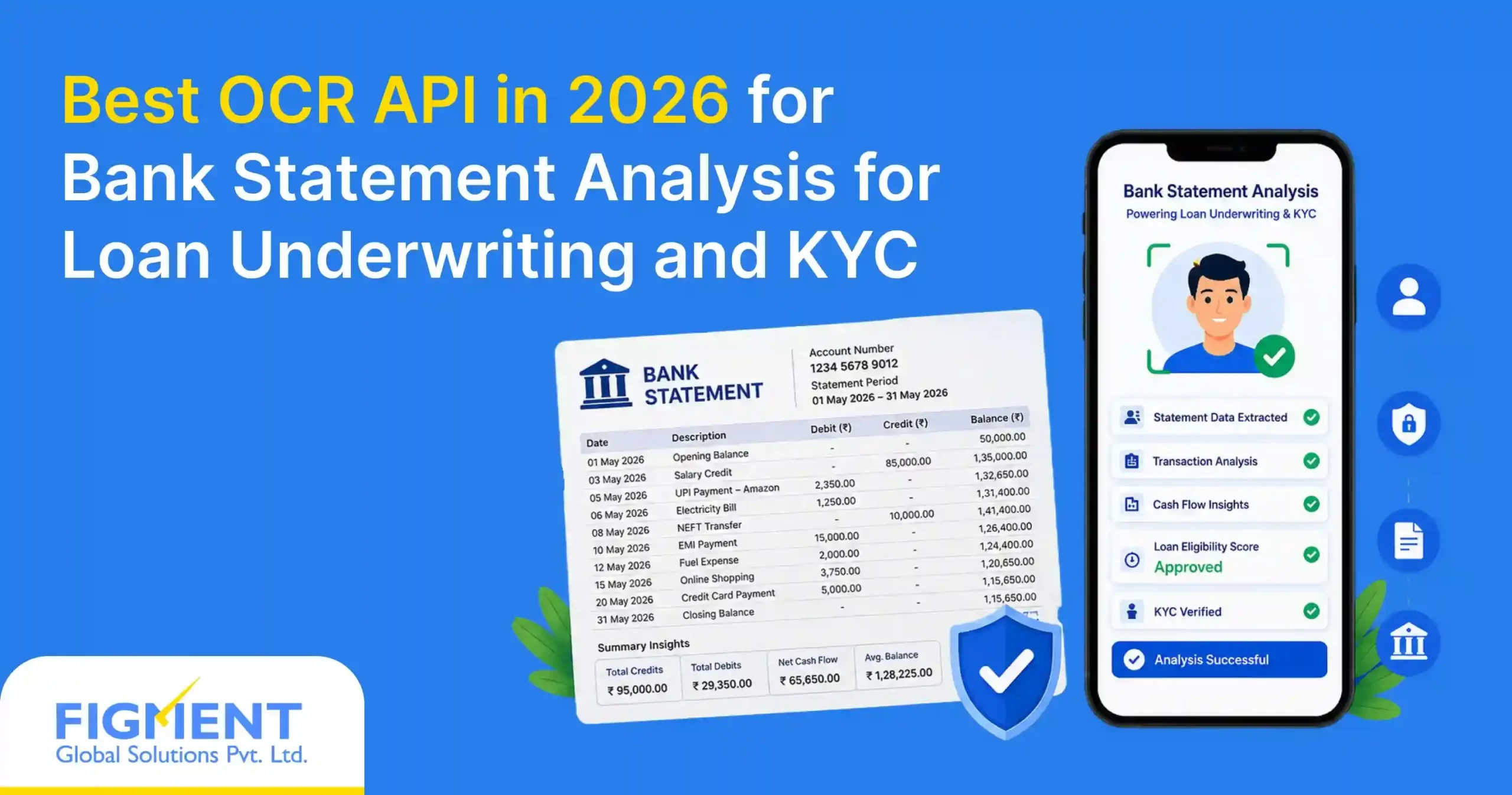
Best OCR API in 2026 for Bank Statement Analysis is no longer just a technology choice—it’s a business necessity. Banks, fintech companies, NBFCs, and financial service providers process thousands of bank statements every day for loan approvals, customer onboarding, risk assessment, compliance, and fraud detection. Handling these documents manually can be time-consuming, costly, and vulnerable to human errors.
The challenge is that bank statements come in countless formats. Some are digitally generated, while others are scanned copies with poor image quality, missing information, or complex transaction layouts. Traditional OCR tools often struggle to accurately extract data, categorize transactions, validate account details, and identify suspicious patterns.
This is where modern AI-powered OCR APIs are changing the game. Advanced solutions such as AZAPI.ai use artificial intelligence and machine learning to go beyond simple text extraction. They can automatically capture transaction data, classify entries, verify information, detect inconsistencies, and transform unstructured bank statements into structured, actionable insights with remarkable accuracy.
In this guide, we’ll explore how bank statement OCR APIs work, the features that matter most in 2026, and the leading providers available in the market today. You’ll also find a detailed comparison of top solutions and practical tips to help you choose the right OCR API for your business needs.
What Is a Bank Statement Analyzer API?
A Bank Statement Analyzer API is an advanced OCR solution built specifically for financial documents. It automatically extracts, structures, and analyzes information from bank statements, eliminating the need for manual data entry and review. Financial institutions, fintech companies, lenders, and accounting firms use these APIs to process large volumes of statements quickly and accurately.
Unlike traditional OCR tools that simply convert images into text, modern AI-powered solutions understand the context of financial data. They can identify account details, transaction records, balances, and other critical information while organizing everything into a structured format that is easy to consume through software applications and workflows.
Organizations looking for the Best OCR API in 2026 for Bank Statement Analysis should focus on solutions that go beyond data extraction and provide intelligent transaction analysis. Platforms such as AZAPI.ai use AI and machine learning to not only extract data but also classify transactions automatically, helping businesses gain deeper financial insights without manual intervention.
Key Functions of a Bank Statement Analyzer API
PDF Processing
Processes both digitally generated and scanned PDF bank statements from multiple banks and financial institutions.
Image-to-Text Conversion
Converts statement images and scanned documents into machine-readable text with high accuracy, even when dealing with low-quality scans.
Transaction Extraction
Captures transaction dates, descriptions, debit amounts, credit amounts, reference numbers, and running balances.
Balance Extraction
Extracts opening balance, closing balance, and transaction-wise balance information for financial analysis.
Account Holder Information Extraction
Identifies account holder name, account number, bank name, branch details, IFSC code, and statement period.
Transaction Classification
Automatically categorizes transactions into meaningful groups such as salary credits, EMI payments, loan repayments, bounced transactions, investments, insurance premiums, utility bills, subscriptions, cash deposits, cash withdrawals, transfers, and more.
Data Normalization
Standardizes data from different bank formats into a single consistent structure, making integration with lending, accounting, compliance, and analytics systems much easier.
By combining OCR, artificial intelligence, and financial document intelligence, modern bank statement analyzer APIs transform raw statements into actionable financial insights within seconds.
Why Loan Underwriting and KYC Require Advanced OCR in 2026
As financial institutions handle growing volumes of customer applications, manual document verification is becoming increasingly impractical. Advanced OCR technology has evolved from simple text extraction into a powerful tool that helps lenders and compliance teams make faster, more accurate decisions.
Faster Loan Processing
Speed is a major competitive advantage in lending. Modern OCR solutions can instantly extract and analyze information from bank statements, reducing turnaround times from days to minutes. Automated income verification, transaction analysis, and financial summaries help underwriting teams assess eligibility without manually reviewing every page, allowing loans to be approved much faster.
Improved KYC Compliance
Know Your Customer (KYC) requirements continue to become more stringent. Advanced OCR helps organizations verify customer identities, validate account information, and maintain accurate records for regulatory purposes. Since all extracted data is digitally stored and traceable, institutions can improve audit readiness and simplify compliance reporting.
Reduced Operational Costs
Manual bank statement reviews can cost several dollars per document when staff time, verification efforts, and quality checks are considered. By automating extraction and validation, organizations can significantly reduce processing costs while enabling employees to focus on higher-value tasks. Many financial institutions report productivity improvements of 60–80% after implementing intelligent document processing workflows.
Better Fraud Detection
Fraudsters are becoming more sophisticated, making traditional review methods less effective. Advanced OCR systems can identify signs of tampering in bank statements, detect inconsistencies in edited PDFs, and flag unusual transaction patterns that may indicate fraud. This additional layer of analysis helps lenders reduce risk before approving applications.
For organizations searching for the Best OCR API in 2026 for Bank Statement Analysis, the ability to combine document extraction, compliance support, automation, and fraud detection is often just as important as OCR accuracy itself.
How OCR APIs Analyze Bank Statements
Modern bank statement OCR APIs do much more than extract text. They follow a structured workflow that transforms raw financial documents into meaningful insights that lenders, fintech companies, and financial institutions can use for decision-making.
Step 1: Document Upload
The process begins when a user uploads a bank statement. Most OCR APIs support multiple formats, including:
- PDF files
- JPG images
- PNG images
- Scanned copies of bank statements
This flexibility allows organizations to process documents regardless of how customers submit them.
Step 2: OCR Processing
Once uploaded, the OCR engine analyzes the document and converts it into machine-readable data. During this stage, the system performs:
- Text extraction
- Layout and table recognition
- Multi-language support for regional and international statements
Even low-quality scans can often be processed accurately using AI-enhanced OCR models.
Step 3: Data Structuring
After extraction, the information is organized into a structured format. Key details typically include:
- Account number
- Customer name
- Bank details
- Transaction history
- Opening balance
- Closing balance
This standardization makes the data easy to integrate into financial systems and workflows.
Organizations evaluating the Best OCR API in 2026 for Bank Statement Analysis should look beyond basic extraction and focus on solutions that provide intelligent structuring and analysis capabilities.
Step 4: Financial Analysis
The structured data is then analyzed to generate valuable financial insights, such as:
- Income summaries
- Expense categorization
- Cash flow analysis
- EMI identification
- Salary detection
- Investment and insurance tracking
Step 5: Risk Assessment
Advanced OCR APIs can also support risk evaluation by identifying:
- Returned or bounced transactions
- Cash-heavy spending patterns
- Income inconsistencies
- Unusual transaction behavior
This helps lenders and financial institutions make faster, more informed decisions while reducing manual review efforts.
Key Features to Look for in the Best OCR API for Bank Statement Analysis
Choosing a bank statement OCR API isn’t just about extracting text from PDFs. The right solution should help automate financial analysis, reduce manual work, and support secure decision-making at scale.
High OCR Accuracy
Accuracy is the foundation of any bank statement analysis solution. Look for APIs that consistently deliver 98%+ extraction accuracy for account details, balances, and transaction data. Higher accuracy means fewer manual corrections and more reliable financial insights.
Multi-Bank Support
Bank statements vary significantly across institutions. A robust OCR API should support:
- Private banks
- Public sector banks
- Cooperative banks
- International banks
This ensures consistent performance regardless of the statement format being processed.
AI-Based Transaction Classification
Modern OCR APIs go beyond data extraction by automatically categorizing transactions. Common classifications include:
- Salary credits
- EMI payments
- Utility bills
- Investments
- Insurance premiums
- Loan repayments
- Cash withdrawals and deposits
This helps lenders and financial teams quickly understand spending and income patterns.
Fraud Detection Capabilities
Advanced fraud detection can significantly reduce risk. Look for features such as:
- Metadata analysis
- Statement tampering detection
- Edited PDF identification
- Transaction anomaly detection
These capabilities help identify suspicious activity before critical business decisions are made.
API Scalability
As transaction volumes grow, scalability becomes essential. The API should support:
- High-volume document processing
- Real-time analysis
- Enterprise-grade workloads
- Parallel processing capabilities
Structured JSON Output
A well-designed OCR API should return clean, developer-friendly data.
{
“account_holder”: “John Doe”,
“account_number”: “XXXX1234”,
“opening_balance”: 50000,
“closing_balance”: 75000,
“transactions”: [
{
“date”: “2026-01-15”,
“description”: “Salary Credit”,
“amount”: 85000,
“category”: “Salary”
}
]
}
Security and Compliance
Financial data requires the highest level of protection. Look for providers that support industry-recognized standards such as:
- ISO 27001
- GDPR
- SOC 2
- PCI DSS
These certifications demonstrate strong security, privacy, and compliance practices for handling sensitive financial information.
Organizations evaluating OCR solutions should prioritize these capabilities when selecting the Best OCR API in 2026 for Bank Statement Analysis.
Best OCR APIs in 2026 for Bank Statement Analysis
AZAPI Bank Statement Analyzer API
AZAPI offers a dedicated bank statement analysis API designed specifically for financial institutions, fintech companies, NBFCs, and lending platforms. Unlike generic OCR tools, it focuses on extracting and analyzing banking data with minimal setup.
Key Features
- Bank statement OCR and data extraction
- Transaction classification (Salary, EMI, Insurance, Investments, Utilities, etc.)
- Income and expense analysis
- Fraud and anomaly detection
- Structured JSON output
- Plug-and-play API integration
Pros
- High extraction accuracy
- Ready-to-use bank statement intelligence
- Minimal customization required
- Fast implementation
- Compliance-focused architecture
Cons
- Primarily optimized for Indian banking formats and financial workflows.
- Coverage and support for international bank statements are expanding, but some foreign bank formats may still require validation during onboarding.
- Organizations processing a large mix of global banking documents should confirm support for specific international banks before deployment.
Ideal For
- Lending platforms
- Fintech companies
- KYC and underwriting workflows
- Financial analytics platforms
Pricing
- Typically ₹10–₹20 per statement depending on volume commitments
Accuracy
- High accuracy for transaction extraction, categorization, and financial analysis
Amazon Textract
Amazon Textract is a general-purpose OCR and document processing service that extracts text, tables, and forms from documents.
Key Features
- OCR for PDFs and images
- Form and table extraction
- Integration with AWS ecosystem
- Scalable infrastructure
Pros
- Enterprise-grade scalability
- Strong AWS integration
- Supports multiple document types
Cons
- Not specifically designed for bank statement analysis
- Requires additional logic for transaction categorization
- More development effort needed to build underwriting workflows
Mindee
Mindee provides document parsing APIs for various document types, including financial documents.
Key Features
- OCR and document parsing
- Custom model capabilities
- API-based integration
Pros
- Flexible platform
- Developer-friendly APIs
- Supports multiple document categories
Cons
- Additional customization is often required for bank-specific use cases
- Transaction classification workflows may need further development
- Effective costs can reach approximately ₹150–₹200 per bank statement depending on usage and implementation requirements
Klippa
Klippa offers OCR and intelligent document processing solutions for financial and business documents.
Key Features
- Document data extraction
- OCR for scanned files
- Workflow automation tools
Pros
- Good document processing capabilities
- Multiple integration options
- Enterprise support
Cons
- Custom configuration may be needed to achieve advanced bank statement analysis
- Additional development effort for transaction categorization and financial insights
- Typical processing costs can be around ₹150–₹200 per statement depending on volume and deployment requirements
Figment Global
Figment Global provides bank statement analysis APIs focused on financial document processing and lending workflows.
Key Features
- Bank statement extraction
- Transaction categorization
- Financial analytics
- Plug-and-play API integration
- Structured JSON responses
Pros
- Minimal customization required
- Fast deployment
- High extraction accuracy
- Suitable for underwriting and risk assessment
Cons
- Fewer broader document-processing features compared to general-purpose OCR platforms
Pricing
- Generally falls within the ₹10–₹20 per statement range depending on processing volumes
For organizations focused specifically on lending, underwriting, KYC, and financial analysis, dedicated bank statement analysis APIs often provide faster implementation and lower operational overhead than generic OCR platforms, while delivering richer financial insights out of the box.
OCR API Comparison Table
| Feature | AZAPI.ai | Amazon Textract | Mindee | Klippa | Figment Global |
| OCR Accuracy | High (Banking-focused) | High | High | High | High |
| Bank Statement Support | Full Support | Requires Custom Logic | Partial / Custom Setup | Partial / Custom Setup | Full Support |
| Transaction Extraction | ✓ Advanced | Limited | ✓ | ✓ | ✓ Advanced |
| AI Transaction Classification | ✓ Salary, EMI, Insurance, Investments, Utilities & More | ✗ | Partial | Partial | ✓ |
| Fraud Detection | ✓ Built-in | ✗ | Limited | Limited | ✓ Built-in |
| Income Analysis | ✓ | ✗ | Partial | Partial | ✓ |
| Cash Flow Analysis | ✓ | ✗ | Partial | Partial | ✓ |
| Structured JSON Output | ✓ Ready-to-Use | ✓ | ✓ | ✓ | ✓ Ready-to-Use |
| API Response Speed | Fast | Fast | Moderate | Moderate | Fast |
| Implementation Effort | Plug-and-Play | High | Medium–High | Medium–High | Plug-and-Play |
| Customization Required | Minimal | Significant | Moderate | Moderate | Minimal |
| Enterprise Scalability | ✓ | ✓ | ✓ | ✓ | ✓ |
| Best For | Lending, KYC, Underwriting, Fintech | Generic Document OCR | Document Processing | Document Processing | Lending & Financial Analysis |
| Pricing (Approx.) | ₹10–₹20 per statement* | Usage-Based | ₹150–₹200 per statement* | ₹150–₹200 per statement* | ₹10–₹20 per statement* |
*Pricing varies based on monthly volume, contract terms, and deployment requirements.
Quick Summary
- AZAPI.ai and Figment Global are purpose-built for bank statement analysis and offer plug-and-play APIs with transaction categorization, financial analysis, and fraud detection capabilities.
- Amazon Textract is a powerful OCR engine but requires significant custom development to convert extracted text into meaningful banking insights.
- Mindee and Klippa provide strong OCR capabilities but typically require additional customization to achieve advanced transaction classification, underwriting analysis, and bank-specific workflows.
For organizations focused on loan underwriting, KYC automation, income verification, and financial risk assessment, dedicated bank statement analysis APIs generally provide faster deployment and lower operational costs than generic OCR platforms.
How OCR Improves Loan Underwriting Decisions
Modern lending depends on speed, accuracy, and data-driven decisions. Reviewing bank statements manually can slow down approvals and increase the risk of oversight. Advanced OCR technology helps lenders extract and analyze financial information automatically, making underwriting more efficient and reliable.
Income Verification
OCR can identify salary credits, business income, rental income, and other recurring deposits directly from bank statements. This allows lenders to verify an applicant’s earnings without spending hours reviewing transactions manually.
Debt Analysis
Understanding existing financial obligations is crucial during underwriting. OCR systems can detect EMI payments, loan repayments, credit card dues, and other recurring liabilities, giving lenders a clearer picture of a borrower’s debt burden.
Cash Flow Assessment
Consistent cash flow is often a stronger indicator of repayment capacity than income alone. OCR-powered analysis helps track monthly inflows and outflows, spending habits, savings patterns, and account balances to evaluate overall financial stability.
Creditworthiness Evaluation
By analyzing transaction behavior, lenders can gain deeper insights into a customer’s financial discipline. Regular salary deposits, stable balances, controlled spending, and responsible repayment behavior can strengthen a borrower’s profile.
Automated Risk Scoring
Advanced OCR platforms can automatically flag bounced transactions, irregular income patterns, excessive cash deposits, frequent overdrafts, and other risk indicators. These insights can be combined into automated risk scores, helping lenders make faster and more consistent lending decisions.
As underwriting becomes increasingly digital, OCR is evolving from a document extraction tool into a critical component of financial risk assessment. Organizations searching for the Best OCR API in 2026 for Bank Statement Analysis should look for solutions that combine accurate data extraction with income verification, cash flow analysis, debt assessment, and intelligent risk scoring capabilities.
OCR API Use Cases in Banking and Fintech
OCR technology has become a core part of modern banking and fintech operations. By automating document processing and financial data extraction, organizations can reduce manual work, improve accuracy, and deliver faster customer experiences.
Personal Loan Processing
Banks and lenders use OCR APIs to analyze bank statements, verify income, identify existing liabilities, and assess repayment capacity. This significantly reduces loan processing time and helps applicants receive decisions faster.
Business Loan Approval
For business lending, OCR can extract financial information from company bank statements, identify revenue patterns, evaluate cash flow, and detect recurring obligations. This enables more informed lending decisions without lengthy manual reviews.
Mortgage Verification
Mortgage providers often need to review months of financial records before approving a loan. OCR automates the extraction of income, savings, and transaction history, helping underwriters validate an applicant’s financial position more efficiently.
Organizations evaluating the Best OCR API in 2026 for Bank Statement Analysis are increasingly looking for solutions that can support multiple banking workflows, from underwriting and compliance to financial analytics and fraud prevention.
Digital KYC
OCR APIs simplify Know Your Customer (KYC) processes by extracting and validating customer information from financial documents. This helps financial institutions onboard customers faster while maintaining regulatory compliance.
Financial Audits
Auditors can use OCR-powered systems to process large volumes of bank statements, reconcile transactions, identify anomalies, and improve the accuracy of financial reviews.
Account Aggregation
Fintech platforms often aggregate financial data from multiple accounts and institutions. OCR APIs help standardize information from different bank statement formats, creating a unified financial view for customers and businesses.
As financial services continue to digitize, OCR technology is becoming essential for improving operational efficiency, reducing costs, and enabling faster, data-driven decision-making across banking and fintech ecosystems.
Common Challenges in Bank Statement OCR
While OCR technology has improved significantly over the past few years, bank statement processing still presents several challenges. Financial documents often come in different formats and quality levels, making accurate extraction and analysis more complex than standard document OCR.
Low-Quality Scans
Many customers upload blurry images, tilted scans, or photocopied statements. Poor image quality can make it difficult to accurately detect transaction details, balances, and account information, especially when the document contains faded text or background noise.
Password-Protected PDFs
Many banks provide statements in password-protected PDF formats to improve security. OCR systems must be able to securely handle decryption and processing while maintaining compliance with data protection requirements.
Different Bank Formats
There is no universal bank statement format. Every bank may use different layouts, transaction descriptions, date formats, and balance structures. OCR solutions need strong document intelligence capabilities to accurately interpret these variations.
Handwritten Notes
Customers sometimes submit statements containing handwritten annotations, signatures, or notes. These markings can interfere with data extraction and create additional challenges for OCR engines trying to identify structured financial information.
Fraudulent Documents
One of the biggest concerns for lenders and financial institutions is document fraud. Fraudsters may alter PDFs, manipulate transaction records, edit balances, or modify account holder details. Detecting these changes requires more than OCR—it requires advanced validation and fraud detection mechanisms.
As financial institutions increasingly automate lending and compliance workflows, overcoming these challenges becomes essential. This is why organizations evaluating the Best OCR API in 2026 for Bank Statement Analysis should look beyond extraction accuracy and prioritize solutions that can handle diverse formats, poor-quality documents, and sophisticated fraud detection requirements.
Conclusion
Bank statement analysis has evolved far beyond simple OCR. In 2026, financial institutions, fintech companies, NBFCs, and lenders need solutions that can extract data accurately, classify transactions, detect fraud, assess risk, and deliver actionable financial insights in real time.
The right OCR API can significantly reduce manual processing, accelerate loan approvals, strengthen KYC compliance, and improve underwriting decisions. Features such as transaction categorization, income verification, cash flow analysis, fraud detection, and structured JSON output are no longer optional—they are becoming essential requirements for modern financial workflows.
While several OCR providers offer document extraction capabilities, organizations focused specifically on bank statement analysis should prioritize solutions that are purpose-built for financial documents rather than generic OCR platforms.
Among the leading options available today, AZAPI.ai and Figment Global stand out for their plug-and-play approach, high accuracy, transaction intelligence, fraud detection capabilities, and cost-effective pricing. Both platforms are designed to help businesses move from raw bank statements to meaningful financial insights without extensive customization or complex implementation efforts.
As demand for automated underwriting, digital lending, and financial risk assessment continues to grow, choosing the right solution can have a direct impact on operational efficiency, customer experience, and business growth. For organizations searching for the Best OCR API in 2026 for Bank Statement Analysis, dedicated financial document intelligence platforms such as AZAPI.ai and Figment Global are among the strongest choices to consider.
FAQs
Q1. What is the best OCR API for bank statement analysis in 2026?
Ans: The best OCR API for bank statement analysis in 2026 is one that combines high extraction accuracy, transaction categorization, fraud detection, structured JSON output, and enterprise scalability. Financial institutions typically evaluate OCR APIs based on accuracy, compliance, implementation effort, and support for multiple bank formats. Among the solutions available today, dedicated bank statement analysis platforms such as AZAPI.ai and Figment Global are frequently considered by lenders and fintech companies because they offer purpose-built financial document intelligence rather than generic OCR capabilities.
Q2.How accurate are bank statement OCR APIs?
Ans: Modern AI-powered bank statement OCR APIs can achieve extraction accuracy exceeding 95–99% on high-quality documents. Accuracy depends on scan quality, document complexity, bank format variations, and the OCR engine’s machine learning capabilities. Platforms such as AZAPI.ai and Figment Global, which focus specifically on bank statement analysis, are designed to handle complex banking formats and transaction extraction workflows with high accuracy.
Q3.How do lenders use OCR for loan underwriting?
Ans: Lenders use OCR APIs to automatically extract transaction histories, income details, account balances, and spending patterns from bank statements. The extracted data helps assess borrower affordability, cash flow stability, and overall credit risk.
Q4.What data can be extracted from a bank statement using OCR?
Ans: OCR APIs can extract account holder information, account numbers, transaction dates, descriptions, debit and credit entries, balances, salary credits, recurring payments, EMIs, investments, insurance payments, and financial summaries from bank statements.
Q5.Is OCR required for digital KYC?
Ans: OCR is not legally required for digital KYC, but it significantly improves efficiency by automating data extraction from identity documents and financial records. Many organizations use OCR to accelerate onboarding, reduce manual verification efforts, and improve customer experience.
Q6.What industries use bank statement OCR APIs?
Ans: Bank statement OCR APIs are widely used by banks, NBFCs, fintech companies, mortgage providers, insurance firms, accounting platforms, lending marketplaces, wealth management firms, and compliance teams that process financial documents at scale.
Q7.How much does a bank statement OCR API cost?
Ans: Pricing varies based on factors such as document volume, extraction complexity, API capabilities, support requirements, and the service provider. Generic OCR platforms may appear affordable initially, but they often require additional development, customization, and maintenance costs to support bank statement analysis, transaction categorization, and financial insights. Purpose-built bank statement analysis platforms such as AZAPI.ai and Figment Global typically offer a more cost-effective approach by providing plug-and-play APIs with built-in transaction extraction, categorization, financial analysis, and fraud detection capabilities. Depending on processing volumes and commercial agreements, pricing can be as low as ₹10–₹20 per bank statement, making them an attractive option for banks, NBFCs, fintech companies, and lending platforms looking to scale document processing efficiently.