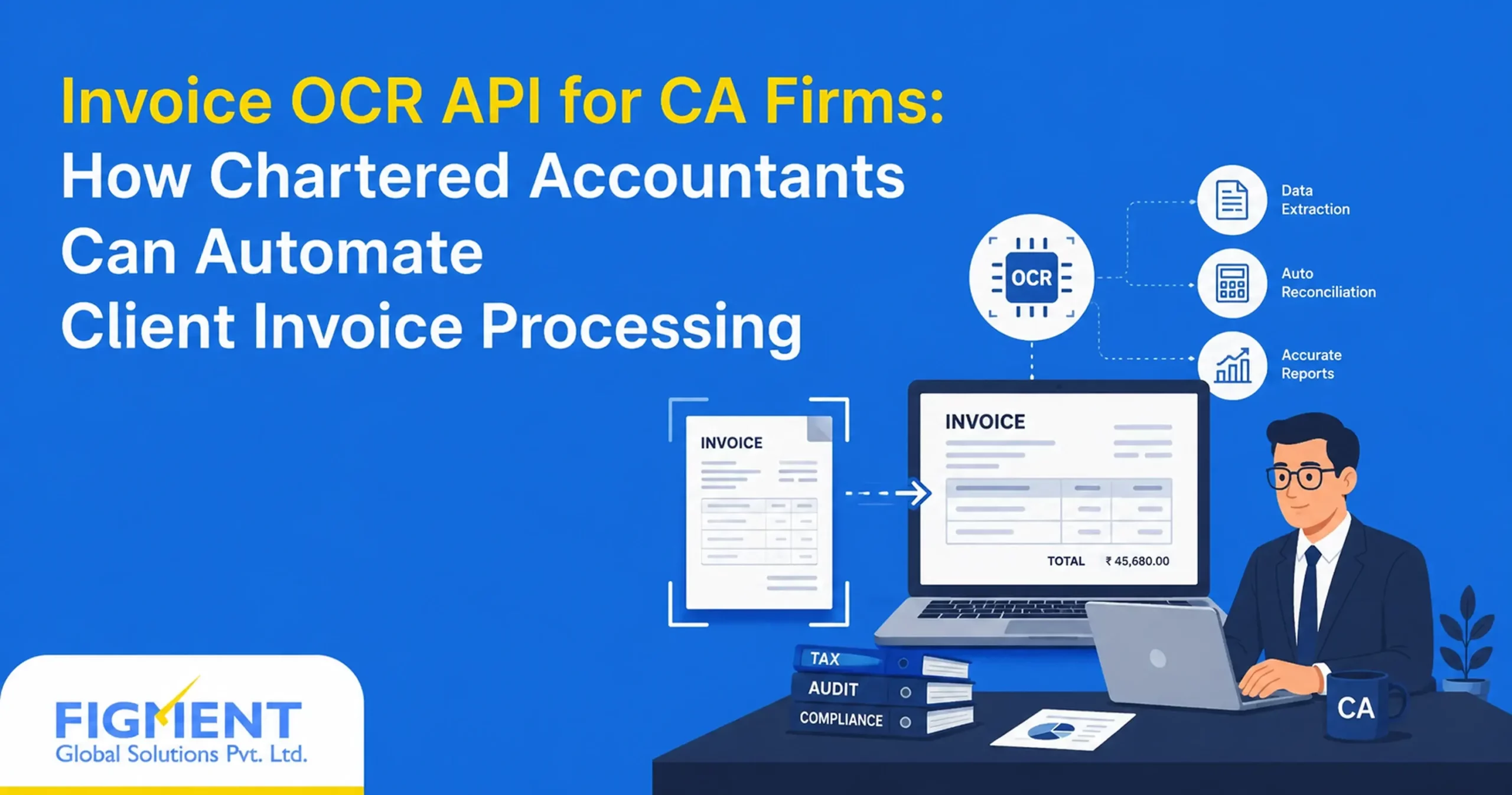
Invoice OCR API for CA Firms is quickly becoming an essential solution for modern accounting practices that handle large volumes of financial documents every day. From purchase invoices and sales invoices to GST bills, vendor invoices, hotel bills, freight invoices, and utility bills, Chartered Accountancy firms spend countless hours collecting, reviewing, and entering invoice data into accounting systems. As the client base grows, this workload increases significantly, making manual processes difficult to scale.
One of the biggest challenges faced by CA firms is that clients submit documents in multiple formats, including PDFs, scanned images, mobile photos, and email attachments. Accountants often need to manually extract details such as invoice numbers, GSTIN, vendor information, taxable values, and tax amounts. This repetitive work not only consumes valuable time but also increases the risk of data-entry errors, missing information, and reconciliation issues during GST filing periods.
The pressure becomes even greater during month-end closings, GST return filing deadlines, audits, and compliance reviews. Teams are forced to spend more time on routine data entry instead of focusing on client advisory services, financial analysis, and business growth opportunities.
This is where intelligent automation can make a significant difference. Platforms like AZAPI.ai help CA firms streamline invoice processing by automatically extracting key invoice data with high accuracy. Using advanced OCR technology, invoices can be processed in seconds, reducing manual effort and improving operational efficiency. Whether a firm manages documents for a few dozen clients or several thousand, automated invoice extraction helps standardize workflows, accelerate bookkeeping, and support faster GST reconciliation.
By adopting an Invoice OCR API, CA firms can reduce processing costs, minimize human errors, and build a more scalable accounting operation that is ready for growing client demands.
Why Invoice Processing Is a Major Challenge for CA Firms
Managing invoices is one of the most demanding tasks for Chartered Accountancy firms. Unlike large organizations that usually generate invoices from standardized ERP systems, CA firms receive documents from a wide range of clients operating in different industries. These may include small businesses, manufacturers, retailers, restaurants, hotels, logistics providers, and e-commerce sellers.
The challenge is that every business uses its own invoice format. Some invoices are professionally designed, while others are simple PDFs, scanned copies, or even mobile phone images. As a result, accountants often spend considerable time identifying and extracting the required information from each document.
For firms handling multiple clients, the workload grows rapidly. Consider a CA firm managing 100 clients, where each client works with around 50 vendors and receives approximately 100 invoices every month. This can translate into hundreds of thousands of invoice data points that need to be reviewed, verified, and entered into accounting systems every year.
At this scale, manual processing becomes increasingly difficult. Even experienced accounting teams can face delays, data-entry mistakes, duplicate entries, and challenges during GST reconciliation. The time spent on routine invoice handling can also reduce the time available for higher-value services such as tax planning, compliance advisory, and financial consulting.
This is why many firms are exploring solutions such as an Invoice OCR API for CA Firms. By automatically extracting invoice data from different formats and layouts, firms can reduce repetitive work, improve accuracy, and process large document volumes more efficiently. As client expectations continue to grow, automation is becoming an important part of building a scalable and productive accounting practice.
What Is an Invoice OCR API?
An Invoice OCR API is a technology that automatically reads invoices, bills, and other financial documents and converts the information into structured, usable data. Instead of manually opening every invoice and entering details into accounting software, the system extracts the required fields within seconds.
The extracted information typically includes invoice number, invoice date, purchase order details, buyer and seller information, GST number, tax amounts, total invoice value, bank details, and line-item data where available. This structured output can then be used for bookkeeping, GST reconciliation, audits, reporting, and accounting workflows.
For Chartered Accountancy firms, handling invoices from different clients often means dealing with hundreds of invoice layouts and document formats. Some invoices arrive as PDFs, while others are scanned copies or mobile phone images. This variation makes manual data entry both time-consuming and prone to errors.
This is where an Invoice OCR API for CA Firms becomes particularly useful. Rather than relying on staff to read and enter information from every invoice, the API automatically identifies key fields and organizes them into a standardized format. The extracted data can include invoice numbers, vendor names, GSTIN details, taxable values, tax components, total amounts, and even detailed line-item information such as HSN/SAC codes, quantities, unit prices, and GST percentages.
By transforming unstructured invoice documents into structured digital data, OCR technology helps accounting teams process documents faster, improve accuracy, and reduce repetitive work. As invoice volumes continue to increase, automated extraction has become an effective way for CA firms to streamline operations and manage large-scale document processing more efficiently.
Why CA Firms Are Adopting Invoice OCR Solutions
Chartered Accountancy firms are under constant pressure to process large volumes of invoices while maintaining accuracy and meeting strict compliance deadlines. As client portfolios grow, traditional manual data entry methods become increasingly difficult to manage efficiently.
One of the biggest advantages of invoice OCR technology is faster bookkeeping. Instead of spending hours entering invoice details manually, accounting teams can automatically capture and organize key information from invoices in a fraction of the time. This allows professionals to focus on higher-value tasks such as financial analysis, advisory services, and client support.
Accuracy is another major factor driving adoption. Manual invoice processing often leads to typing mistakes, missing entries, and inconsistencies. Automated extraction helps reduce these errors by capturing data directly from the source document.
OCR solutions also support faster GST compliance by automatically extracting important details such as GSTIN, invoice date, invoice number, taxable value, and tax breakdown. Having this information readily available simplifies reconciliation and return preparation.
In addition, digital invoice extraction improves audit readiness. Firms can maintain organized, searchable records that are easy to retrieve during audits, assessments, or client reviews.
Perhaps the most important benefit is scalability. As the number of clients and invoices increases, firms can handle higher workloads without needing to expand their data-entry teams at the same pace. This creates a more efficient and sustainable operational model.
For firms looking to improve productivity, reduce manual effort, and manage growing document volumes, adopting an Invoice OCR API for CA Firms is becoming a practical step toward building a faster, more scalable accounting workflow.
Common Use Cases for Chartered Accountants
An Invoice OCR API for CA Firms can support multiple accounting and compliance processes that traditionally require significant manual effort. By converting invoice data into structured digital information, firms can streamline day-to-day operations and improve overall efficiency.
One of the most common applications is GST return preparation. Accounting teams can automatically extract critical details such as vendor GSTIN, taxable value, CGST, SGST, and IGST from invoices. This reduces manual data entry and helps simplify GST reconciliation and filing activities.
Another important use case is accounting and bookkeeping. Instead of manually entering invoice details, firms can capture key information such as vendor name, invoice number, invoice date, and invoice amount directly from documents. This speeds up bookkeeping workflows while reducing the risk of data-entry errors.
Invoice OCR technology is also widely used for expense management. Businesses often receive a large number of hotel bills, travel expenses, fuel receipts, and vendor invoices every month. Automating data extraction makes it easier to record, categorize, and track these expenses accurately.
For firms handling long-term client records, document digitization is another valuable application. Years of invoice archives can be converted into searchable digital records, making document retrieval much faster and more organized.
Internal audits also become more efficient when invoice data is digitized and indexed. Auditors can quickly locate supporting documents, verify transactions, and validate financial records without searching through physical files or scattered folders.
As accounting firms continue to manage increasing document volumes, OCR-powered invoice processing is helping them improve productivity, strengthen compliance processes, and deliver faster services to their clients.
Why Building Invoice OCR In-House Is Difficult
Many CA firms recognize the benefits of invoice automation, but building an in-house OCR solution is often far more challenging than it appears. The biggest obstacle is the sheer variety of invoice formats that firms receive from different clients and vendors.
A typical accounting practice may process invoices from manufacturers, retailers, logistics companies, hotels, service providers, and many other businesses. Each vendor can use a completely different invoice layout, with important fields such as invoice number, GST details, tax amounts, and totals appearing in different positions.
To create a reliable extraction system, firms need access to large volumes of invoice data from multiple industries and vendors. Collecting, organizing, and preparing these datasets is a time-consuming process. Without sufficient data diversity, the system may perform well on some invoices but struggle with others.
This is one reason why many organizations explore an Invoice OCR API for CA Firms instead of developing their own solution from scratch. Building a robust model requires continuous training and testing across thousands of document variations to maintain accuracy.
Another major challenge is annotation. Every invoice must be manually labeled to identify fields such as invoice number, vendor name, GSTIN, taxable value, tax components, and total amount. Creating and maintaining these labeled datasets can require a significant investment of time, resources, and expertise.
Even after deployment, the work does not stop. New clients bring new invoice formats, vendors update their templates, and industries introduce different documentation styles. As a result, the OCR model requires ongoing updates and monitoring to ensure consistent performance.
For many CA firms, the cost and complexity of building, training, and maintaining an in-house invoice extraction system can outweigh the benefits, making automation solutions a more practical and scalable approach.
Features CA Firms Should Look for in an Invoice OCR Provider
Choosing the right invoice OCR solution is important for CA firms that handle large volumes of financial documents every day. Not all OCR systems are designed to meet the requirements of accounting and GST compliance workflows, so evaluating key features is essential before implementation.
One of the most important capabilities is GST-aware extraction. Since GST compliance plays a central role in Indian accounting, the solution should accurately capture fields such as GSTIN, taxable amount, CGST, SGST, IGST, invoice number, and invoice date. Accurate tax data extraction helps simplify reconciliation and return preparation.
Support for multiple document formats is equally important. Clients often submit invoices in PDF format, while others may send scanned images or photographs taken from mobile devices. A reliable OCR solution should be able to process PDFs, JPG files, PNG images, and mobile captures without requiring manual adjustments.
Another key consideration is multi-vendor support. An effective Invoice OCR API for CA Firms should be capable of handling thousands of invoice layouts from different vendors, industries, and business types. The system should adapt to varying invoice structures while maintaining consistent extraction accuracy.
Integration capabilities also play a major role in improving workflow efficiency. The OCR solution should offer APIs that can connect seamlessly with internal portals, accounting software, document management systems, and ERP platforms. This helps eliminate repetitive data transfers and reduces manual intervention.
Finally, firms should consider scalability and bulk processing capabilities. During GST filing periods, audits, and month-end accounting cycles, invoice volumes can increase significantly. A solution that supports processing thousands of invoices per day can help maintain productivity and prevent operational bottlenecks.
By focusing on these features, CA firms can select a solution that improves efficiency, supports compliance requirements, and scales alongside business growth.
Comparison of Popular Invoice OCR Providers for CA Firms
Pricing is often one of the biggest deciding factors when evaluating invoice OCR solutions. However, CA firms should compare providers based on accuracy, GST extraction capabilities, invoice processing costs, integration options, scalability, and long-term ownership costs rather than looking at subscription fees alone.
| Provider | Focus Area | Invoice Accuracy* | GST Extraction | API Access | PDF & Image Support | Monthly Cost | Setup Charges | Pricing Model |
| AZAPI.ai | Invoice OCR, GST Invoice Processing, Financial Documents | High | Strong | Yes | Yes | None | None | Wallet recharge, pay-per-invoice ($0.015-$0.025) |
| Figment Global | Invoice OCR & Data Extraction | High | Available | Yes | Yes | None | None | Wallet recharge, pay-per-invoice ($0.015-$0.025) |
| RPACPC | OCR & Process Automation | High | Available | Yes | Yes | None | None | Wallet recharge, pay-per-invoice ($0.015-$0.025) |
| Mindee | Developer-Focused OCR APIs | High | Available | Yes | Yes | €44/month Starter, €179/month Pro, €584/month Business | None publicly listed | Subscription + usage charges |
| Klippa | Invoice Processing & AP Automation | High | Available | Available on Custom Plan | Yes | €95/month Effective, €275/month Premium | Additional integration costs may apply | Subscription-based |
| Nanonets | Intelligent Document Processing | High | Available | Yes | Yes | Free starter credits, Enterprise custom pricing | None publicly listed | Usage-based pricing |
Detailed Pricing Overview
Mindee
- Starter: €44/month with 500 credits per month
- Pro: €179/month with 2,500 credits per month
- Business: €584/month with 10,000 credits per month
- Additional credits billed separately (€0.035-€0.05 per page depending on plan)
Klippa
- Effective Plan: €95/month (up to 4,000 invoices annually)
- Premium Plan: €275/month (up to 12,000 invoices annually)
- Custom Enterprise pricing available
- ERP and accounting integrations may involve additional fees depending on requirements
Nanonets
- Free plan includes $200 in credits
- Growth plan uses volume-based pricing
- Complex AI extraction operations are priced around $0.30 per run, with invoice workflows typically involving multiple processing steps
- Enterprise pricing is custom based on volume and deployment requirements
Key Evaluation Criteria for CA Firms
Before selecting an Invoice OCR solution, compare:
- Invoice extraction accuracy
- GSTIN extraction accuracy
- Line-item extraction support
- HSN/SAC extraction
- CGST, SGST, and IGST extraction
- Purchase Order extraction
- Vendor and buyer information extraction
- PDF invoice support
- Mobile image support
- Multi-page invoice handling
- Bulk invoice processing
- API availability
- Accounting software integration
- ERP integration
- Processing speed
- Data security
- Custom field extraction
- Monthly subscription commitments
- Setup and onboarding costs
- Pay-per-use flexibility
- Technical support quality
For many accounting firms, the most cost-effective solution is often the one that combines high extraction accuracy with transparent pricing and minimal upfront commitments. This is especially important when implementing an Invoice OCR API for CA Firms across multiple clients with fluctuating invoice volumes.
Sample Invoice OCR Workflow for CA Firms
An automated invoice processing workflow can significantly reduce the time spent on manual data entry while improving accuracy and consistency across accounting operations. A typical invoice OCR workflow used by Chartered Accountancy firms involves a few simple steps.
Step 1: Invoice Collection
The process begins when a client uploads an invoice. Documents may be submitted through a client portal, email, mobile application, document management system, or shared folder. The invoice can be in PDF format, a scanned document, or an image captured using a mobile device.
Step 2: Invoice Processing
Once received, the invoice is automatically sent to the OCR system for analysis. The OCR engine reads the document, identifies relevant fields, and prepares the information for extraction.
Step 3: Data Extraction
The system converts the unstructured invoice into structured data by extracting key details such as:
- Vendor Name
- Invoice Number
- Invoice Date
- GSTIN
- Taxable Value
- CGST, SGST, and IGST
- Total Invoice Amount
- Purchase Order Details (where available)
- Line Item Information
Step 4: Workflow Integration
After extraction, the structured data is automatically transferred into business workflows. Depending on the firm’s requirements, the information can be pushed into:
- Accounting software
- ERP systems
- Internal client portals
- Bookkeeping platforms
- GST reconciliation workflows
- Audit and compliance systems
Step 5: Verification and Approval
The accounting team reviews the extracted information and validates any exceptions or low-confidence fields. Once verified, the invoice data is approved and becomes part of the firm’s accounting and compliance records.
By implementing an Invoice OCR API for CA Firms, this workflow can transform invoice processing from a manual, time-intensive task into a streamlined digital process, helping firms improve productivity, accuracy, and scalability while handling growing client document volumes.
REST API Integration Example
One of the key advantages of modern invoice OCR solutions is their ability to integrate directly with existing accounting, ERP, and document management systems through REST APIs. This allows CA firms to automate invoice processing without changing their existing workflows.
Python Integration Example
import requests
url = “https://adv-ocr.azapi.ai/ind0003b”
headers = {
“Authorization”: “YOUR_API_KEY”
}
files = {
“file”: open(“invoice.pdf”, “rb”)
}
response = requests.post(
url,
headers=headers,
files=files
)
print(response.text)
Sample JSON Response
After processing the invoice, the API returns structured JSON data that can be directly consumed by accounting software, ERP systems, GST workflows, or internal applications.
{
“invoice_number”: “INV-2025-001”,
“invoice_date”: “2025-06-15”,
“po_number”: “PO-45871”,
“po_date”: “2025-06-10”,
“vendor_name”: “ABC Traders Pvt Ltd”,
“vendor_gstin”: “27ABCDE1234F1Z5”,
“vendor_address”: “Mumbai, Maharashtra”,
“buyer_name”: “XYZ Enterprises”,
“buyer_gstin”: “27XYZAB1234K1Z8”,
“buyer_address”: “Pune, Maharashtra”,
“taxable_value”: 10550.00,
“cgst”: 950.00,
“sgst”: 950.00,
“igst”: 0.00,
“total_tax”: 1900.00,
“invoice_value”: 12450.00,
“bank_details”: {
“account_number”: “XXXXXX1234”,
“ifsc”: “HDFC0001234”
},
“line_items”: [
{
“item_name”: “Laptop Bag”,
“hsn_sac”: “4202”,
“qty”: 10,
“uom”: “PCS”,
“unit_price”: 500.00,
“cgst_percent”: 9,
“sgst_percent”: 9,
“igst_percent”: 0,
“cgst”: 450.00,
“sgst”: 450.00,
“igst”: 0.00,
“amount”: 5000.00
},
{
“item_name”: “Wireless Mouse”,
“hsn_sac”: “8471”,
“qty”: 20,
“uom”: “PCS”,
“unit_price”: 277.50,
“cgst_percent”: 9,
“sgst_percent”: 9,
“igst_percent”: 0,
“cgst”: 500.00,
“sgst”: 500.00,
“igst”: 0.00,
“amount”: 5550.00
}
]
}
Using an Invoice OCR API for CA Firms, this structured output can be automatically pushed into accounting platforms, GST reconciliation systems, ERP software, audit workflows, and internal applications, significantly reducing manual data-entry effort and improving processing efficiency.
Expected ROI for CA Firms
Investing in invoice automation is not just about reducing manual work-it can have a direct impact on operational efficiency, turnaround times, and the overall profitability of a CA firm. As invoice volumes increase, even small productivity gains can result in significant long-term savings.
One of the most immediate benefits is a reduction in data-entry effort. Instead of manually reviewing and entering information from every invoice, firms can automatically process thousands of invoices and extract key accounting data in a structured format. This allows teams to spend less time on repetitive administrative tasks.
Improved productivity is another major advantage. Accountants and finance professionals can focus more on client advisory services, financial analysis, audits, and compliance activities rather than invoice data entry. This helps firms utilize skilled resources more effectively.
Automation also contributes to faster turnaround times. With invoice information readily available, bookkeeping processes can be completed more quickly, GST reconciliation becomes easier, and filing deadlines can be managed more efficiently. Faster processing often leads to improved client satisfaction and smoother internal operations.
Perhaps the most valuable long-term benefit is scalability. As a firm’s client base grows, invoice volumes increase accordingly. Without automation, this often requires hiring additional staff to manage the workload. By implementing an Invoice OCR API for CA Firms, organizations can handle significantly higher document volumes without proportionally increasing operational overhead.
Typical Business Benefits
- Reduced manual invoice-entry workload
- Faster bookkeeping cycles
- Improved GST reconciliation efficiency
- Lower risk of data-entry errors
- Better audit readiness
- Faster client service delivery
- Increased staff productivity
- Ability to manage higher invoice volumes
- Scalable operations without large increases in manpower
For many CA firms, the return on investment becomes visible through time savings, improved accuracy, and the ability to support more clients using the same operational resources.
Best Practices for Successful Adoption of Invoice OCR
Implementing invoice OCR can deliver significant efficiency gains, but the best results are achieved when firms follow a structured adoption strategy. Rather than automating every workflow at once, CA firms should focus on a phased approach that maximizes value while maintaining accuracy and control.
A practical starting point is to identify high-volume clients. Clients that generate large numbers of purchase invoices, expense bills, vendor invoices, or GST documents often provide the quickest return on investment. Automating these document-heavy accounts can immediately reduce manual workload and demonstrate measurable productivity improvements.
While automation can significantly reduce data-entry effort, maintaining validation workflows remains important. Critical fields such as invoice number, GSTIN, taxable value, tax amounts, and total invoice value should be reviewed before accounting entries are finalized. Human verification helps ensure accuracy and supports compliance requirements.
Document standardization can also improve extraction quality. Encouraging clients to submit invoices in PDF format whenever possible typically results in better data extraction compared to low-resolution images or unclear scans. Establishing clear document submission guidelines can reduce processing issues and improve workflow consistency.
Another important best practice is ongoing performance monitoring. Firms should regularly evaluate extraction accuracy across different industries, vendors, and invoice formats.
Monitoring results helps identify exceptions, improve workflow rules, and maintain consistent data quality as new clients and document types are introduced.
Recommended Implementation Approach
- Begin with high-volume clients and invoice-heavy workflows
- Keep verification steps for critical accounting fields
- Encourage digital PDF submissions where possible
- Track extraction accuracy regularly
- Test across multiple vendor formats and industries
- Review exception cases and update workflows when needed
- Integrate OCR outputs directly into accounting and GST processes
By following these best practices, firms can maximize the benefits of an Invoice OCR API for CA Firms, achieving faster adoption, higher accuracy, and a smoother transition from manual invoice processing to automated document workflows.
Conclusion: The Future of Invoice Processing for CA Firms
As client portfolios continue to grow and compliance requirements become more demanding, manual invoice processing is becoming increasingly difficult for CA firms to manage efficiently. Teams that rely heavily on manual data entry often face challenges related to scalability, accuracy, turnaround times, and operational costs.
Invoice OCR technology offers a practical solution by transforming unstructured invoices into structured, actionable data. By automating invoice extraction, firms can reduce manual effort, improve bookkeeping efficiency, accelerate GST workflows, and process invoices from a wide variety of vendors and industries with greater consistency.
The benefits extend beyond simple automation. Firms can improve productivity, strengthen audit readiness, enhance data accuracy, and serve a larger client base without proportionally increasing staffing requirements. As a result, invoice OCR is rapidly becoming an important component of modern accounting operations.
When evaluating an Invoice OCR API for CA Firms, organizations should compare factors such as extraction accuracy, GST field coverage, API integration capabilities, processing speed, scalability, support quality, and pricing transparency. Popular providers in this space include AZAPI.ai, Klippa, Mindee, Nanonets, Figment Global, and RPACPC, each offering different strengths depending on business requirements.
Among these options, AZAPI.ai is often a strong choice for CA firms looking for a cost-effective and scalable invoice automation solution.
The platform offers flexible pay-per-use pricing, with no monthly subscription commitments, no setup charges, and no hidden fees. Its wallet-based pricing model allows firms to pay only for actual usage, making it suitable for both small practices and large accounting organizations.
In addition, AZAPI.ai is designed for easy REST API integration and supports a wide range of invoice formats, including PDFs, scanned documents, and mobile-captured images. With reported extraction accuracy of up to 99.91%+ across diverse invoice formats, it can help firms automate invoice processing while maintaining high data quality standards.
As accounting workflows continue to evolve, adopting invoice OCR technology can provide CA firms with a significant competitive advantage by improving efficiency, reducing operational overhead, and enabling sustainable growth.
FAQs
Q1. What is the best Invoice OCR API for CA firms?
Ans: The best Invoice OCR API for CA firms depends on factors such as extraction accuracy, GST support, API integration capabilities, pricing flexibility, and scalability. Firms handling large volumes of invoices typically prefer solutions that can accurately extract invoice numbers, GSTINs, tax amounts, vendor details, and line-item information while integrating seamlessly with their accounting workflows. Providers such as AZAPI.ai, Figment Global, and RPACPC are commonly evaluated for invoice processing and document extraction use cases. The right choice depends on the firm’s invoice volume, compliance requirements and automation goals.
Q2. Why are CA firms adopting Invoice OCR APIs?
Ans: CA firms process thousands of invoices every month across multiple clients and industries. Manual data entry can be time-consuming, error-prone, and difficult to scale. Invoice OCR APIs help firms:
- Reduce manual invoice entry
- Improve bookkeeping efficiency
- Accelerate GST reconciliation
- Reduce processing errors
- Improve audit readiness
- Handle higher client volumes without proportionally increasing manpower
These benefits make invoice automation increasingly important for modern accounting practices.
Q3. What is considered a good invoice OCR accuracy rate?
Ans: Invoice OCR accuracy depends on factors such as invoice formats, scan quality, image resolution, handwritten notes, and complex layouts. In practice, 90%+ accuracy is considered good, while 95%+ is suitable for most production environments. Some providers, including AZAPI.ai (up to 99.91%+) and RPACPC (up to 98%+), report higher accuracy rates. However, CA firms should always validate OCR performance using their own client invoices, focusing on key fields like invoice number, GSTIN, invoice date, tax values, vendor details, and line items to ensure it meets their workflow requirements.
Q4. Can Invoice OCR APIs extract GST details automatically?
Ans: Yes. Modern invoice OCR solutions can automatically extract GST-related information, including:
- GSTIN
- Invoice Number
- Invoice Date
- Taxable Value
- CGST
- SGST
- IGST
- Total Invoice Value
This data can be used directly for bookkeeping, GST reconciliation, compliance workflows, and return preparation.
Q5. Which Invoice OCR API is suitable for Indian GST invoice processing?
Ans: For Indian accounting workflows, firms generally look for solutions optimized for GST invoices and financial documents. Important factors include GST field extraction, support for Indian invoice formats, API integration, bulk processing capabilities, and flexible pricing. AZAPI.ai, Figment Global, and RPACPC are often considered because of their focus on invoice extraction and support for Indian business document workflows.
Q6. Can Invoice OCR APIs extract line-item details from invoices?
Ans: Yes Advanced invoice OCR systems can extract detailed line-item information, including:
- Item Name
- HSN/SAC Code
- Quantity
- Unit of Measure (UOM)
- Unit Price
- Tax Percentage
- CGST, SGST, and IGST values
- Total Line Amount
Line-item extraction is particularly useful for accounting, inventory reconciliation, GST compliance, and financial reporting.
Q7. How much does an Invoice OCR API cost for CA firms?
Ans: The cost of an Invoice OCR API varies depending on the provider, invoice volume, extraction requirements, and pricing model. Some providers offer monthly subscription plans, while others use pay-per-use pricing. Solutions such as AZAPI.ai, Figment Global, and RPACPC typically provide usage-based pricing without setup fees or fixed monthly commitments, making them suitable for firms with varying invoice volumes. When comparing costs, firms should consider:
- Cost per invoice
- Monthly subscription fees
- Setup charges
- API access costs
- Volume discounts
- Support and maintenance costs
Q8. Can Invoice OCR APIs handle invoices from different vendors?
Ans: Yes. One of the biggest advantages of Invoice OCR technology is its ability to process invoices from thousands of different vendors, even when layouts, formats, and field positions vary significantly. This makes OCR particularly valuable for CA firms that manage documents from multiple clients, suppliers, and industries.
Q9. What document formats are typically supported by Invoice OCR APIs?
Ans: Most modern invoice OCR platforms support:
- PDF invoices
- Scanned PDFs
- JPG images
- PNG images
- Mobile phone captures
- Multi-page invoices
The exact level of support may vary depending on the provider and workflow configuration.
Q10. How should a CA firm choose an Invoice OCR provider?
Ans: When selecting an Invoice OCR solution, firms should compare:
- Invoice extraction accuracy
- GST field extraction capability
- Line-item extraction support
- API availability
- Bulk processing capacity
- Processing speed
- Accounting software integration
- ERP integration
- Data security
- Technical support
- Pricing transparency
- Setup and maintenance costs
Many firms evaluate providers such as AZAPI.ai, Figment Global, RPACPC, Mindee, Klippa, and Nanonets before conducting proof-of-concept testing with their own invoice datasets.
Q11. Can Invoice OCR APIs integrate with accounting software and ERP systems?
Ans: Yes. Most modern Invoice OCR APIs provide REST APIs and integration capabilities that allow extracted invoice data to be automatically pushed into accounting software, ERP platforms, GST reconciliation tools, document management systems, and internal business applications. This reduces manual data transfer and helps create a more automated accounting workflow.
Q12. Is Invoice OCR suitable for small and mid-sized CA firms?
Ans: Absolutely. Invoice OCR is not limited to large enterprises. Small and mid-sized CA firms can benefit significantly by reducing manual workload, improving productivity, and handling more client documents without increasing operational costs. Flexible pay-per-use models offered by some providers also make adoption easier for firms that do not want long-term subscription commitments.